Miami Real Estate Photography: How Professional Photos Help Listings Sell Faster

Part of our Real Estate Photography Pricing guide
Ready to get started?
In Miami specifically — where the median single-family home price exceeds $650,000 and nearly half of buyers are international — the quality of listing photography is often the difference between serious buyer inquiries and a listing that sits.
The Miami Real Estate Market Context: Why Photography Matters More Here
Miami is not a typical American real estate market. Several factors make visual content disproportionately important here compared to markets like suburban Ohio or rural Texas:
International buyer composition. According to the Miami Association of Realtors, approximately 45% of Miami-Dade residential purchases involve foreign buyers, predominantly from Latin America (Brazil, Colombia, Venezuela, Argentina), Canada, and Europe. These buyers overwhelmingly make first-contact decisions — and often final decisions — based entirely on digital media. They cannot easily schedule weekend showings. Professional photography is not a supplement to the in-person experience; it is the experience for this buyer segment.
Median price point. The Miami metro median single-family home price exceeded $650,000 in 2025, with condos averaging around $430,000. At these price points, buyers expect a level of visual presentation commensurate with the investment. Photos shot on an iPhone in an unfurnished condo feel incongruent with a $700,000 ask — and they signal to buyers that the seller is not serious.
Market competition. Miami-Dade typically carries 4–6 months of housing inventory, creating genuine competition between comparable listings. When a buyer has 12 similar waterfront condos in their price range, photo quality becomes a primary filter. Listings with professional photos get the showing; the others do not.
The luxury segment concentration. Neighborhoods like Fisher Island, Star Island, Indian Creek, Coconut Grove, and Coral Gables regularly see $5M–$50M+ transactions. At these levels, professional photography — along with drone aerials, Zillow 3D virtual tours, and twilight sessions — is simply assumed. Cutting media costs on a $10M listing to save $800 is the most counterproductive math in real estate.
The Statistics: What Professional Photography Actually Does
Days on Market
In Miami's competitive market, that translates to meaningful differences:
- A listing that would take 60 days with mediocre photos may sell in 41 days with professional photos
- Faster sales reduce carrying costs: mortgage payments, HOA fees, taxes, and insurance
- For investment properties and estate sales, faster transactions directly increase net proceeds
Online Views and Engagement
In a market where digital search precedes every physical showing, views are the top-of-funnel metric that drives everything downstream.
Zillow's internal data shows that listings with 20+ high-quality photos spend significantly less time on the platform before going under contract than listings with fewer or lower-quality images.
Offer Prices
Multiple studies, including analysis from VHT Studios and Redfin, show that professionally photographed homes sell for $3,400–$11,200 more than comparable homes with non-professional photography. In percentage terms, that typically runs 1–3% of sale price — which at Miami's median prices represents $6,500–$19,500 in additional proceeds.
The mechanism: professional photos attract more buyers, more buyers generate more showings, more showings generate competing interest, competing interest produces higher offers.
Virtual Tours and International Buyers
For Miami's international buyer segment specifically, virtual tours are often what converts a remote buyer into a serious offer. A Brazilian buyer in São Paulo cannot fly to Miami for a showing — but they can spend 45 minutes in a Zillow 3D tour and make an offer based on that experience.
What Makes Miami Photography Unique: Light, Luxury, and Waterfront
The Miami Light Advantage
South Florida's light is genuinely different from most American markets — and it requires specific expertise to work with rather than against.
The challenge: Miami's intense tropical sun creates deep shadows and blown-out highlights that budget cameras (and inexperienced photographers) cannot balance. A bright window view of Biscayne Bay becomes a blown-out white rectangle in an underexposed interior shot. The solution is HDR photography — multiple exposures blended in post-processing — which requires specific equipment, technical skill, and editing expertise.
The opportunity: When handled correctly, Miami's light creates images of extraordinary depth and warmth that northern-market listings simply cannot match. A golden-hour exterior shot of a Coral Gables Mediterranean with amber light on limestone facades, deep blue sky, and lush tropics landscaping is intrinsically compelling in a way that no amount of editing can manufacture for a Cleveland colonial in February.
Mike Brun at Estate Shutter Florida schedules most interior shoots during the "golden window" — approximately 90–120 minutes after sunrise for east-facing properties, or 90–120 minutes before sunset for west-facing properties — to capture Miami's best light.
Waterfront and Water-View Properties
Approximately 30% of Miami-Dade real estate transactions involve waterfront or water-view properties — Intracoastal, ocean, bay, canal, or lake frontage. These properties have a premium selling point that must be photographed, not just described.
Key techniques for waterfront Miami properties:
Establish the water relationship first. The hero shot should show the home in relationship to water — either from the water side showing the property's dock or seawall, or from above (drone) showing both the home and the water it fronts.
Capture the view from inside. Buyers buying Brickell Bay or Edgewater condos are paying for the view. A photo of the view itself — Biscayne Bay at dusk from a 30th-floor unit — is not redundant; it is the core asset. Shoot it with HDR and a tripod.
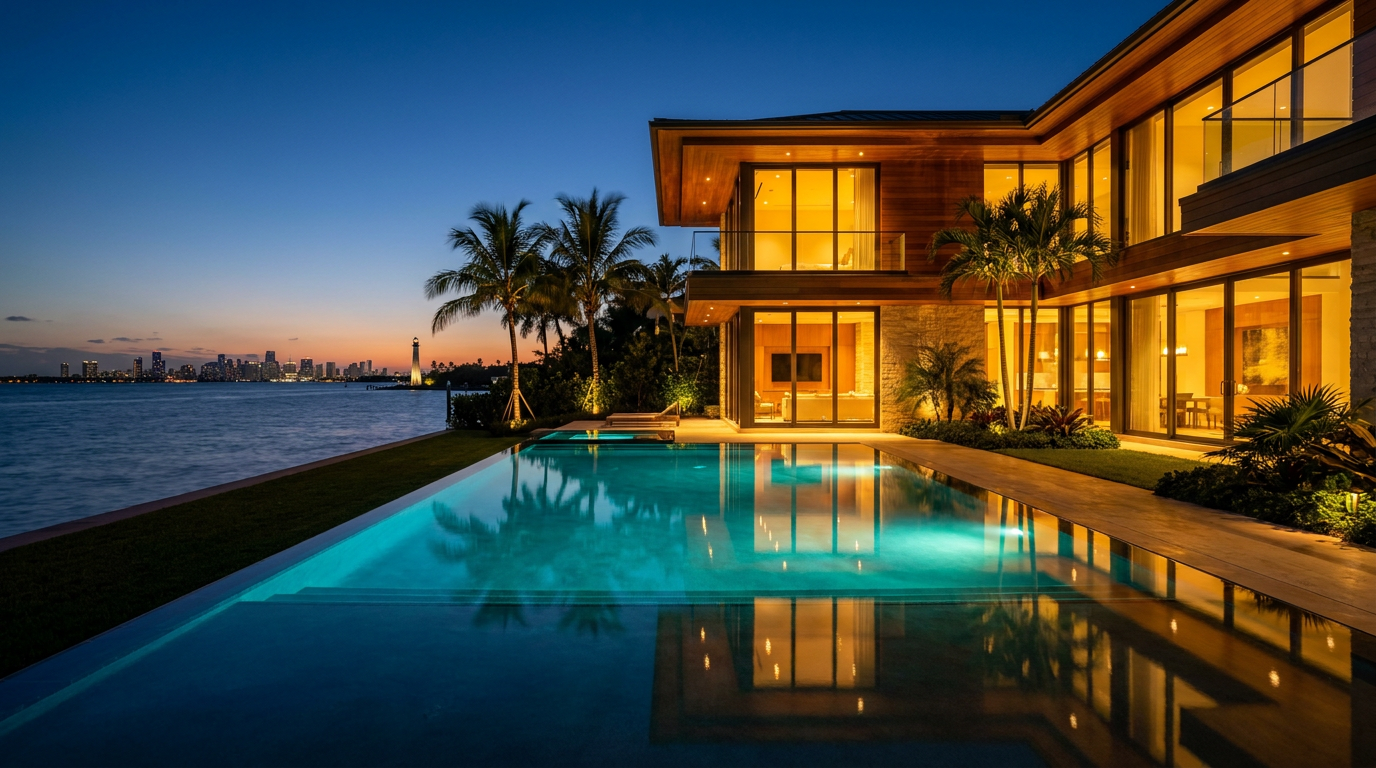
Show the dock, pool, and outdoor living space. Miami buyers expect outdoor living areas. The pool deck, dock, and any covered outdoor kitchen are premium features that deserve dedicated shots, not background elements in a wide shot.
The Luxury Market: Brickell, Coral Gables, Coconut Grove, and Beyond
Miami's luxury market requires a specific photographic approach:
Brickell and Downtown condos: High-rise condos photograph best at golden hour from the east (morning) or with twilight city views at dusk. The combination of interior warmth and exterior city glow creates the dramatic "Miami nightlife luxury" aesthetic that resonates with international buyers.
Coral Gables and Pinecrest estates: These Mediterranean Revival and Spanish Colonial properties photograph best with exterior shots that showcase architectural detail — arched doorways, clay tile roofs, mature tree canopies, and terrazzo or limestone hardscaping. Wide-angle exterior shots at f/8 with natural light and drone overheads showing lot size are the essential shots for this market.
Coconut Grove: One of Miami's most architecturally diverse neighborhoods, with everything from modernist glass boxes to 1920s bungalows. Coconut Grove properties require neighborhood context shots — the tree canopy, the walkable streets, the bay glimpses through foliage.
Miami Beach, South Beach, Mid-Beach, North Beach: Waterfront condos and single-family homes on the barrier island need to show proximity to both the ocean and the city. Drone aerials showing the property's position between Biscayne Bay and the Atlantic Ocean are uniquely compelling for international buyers who may not know Miami's geography.
Wynwood, Edgewater, Little Havana: Emerging and established artistic neighborhoods where the property's surroundings are part of the selling story. Street-level exterior shots showing neighborhood context, murals, or urban energy add narrative that pure property photos do not.
Aventura, Sunny Isles Beach, Bal Harbour: The "Millionaire's Mile" corridor where condo towers dominate and ocean proximity is the core value. Professional drone and ocean-facing interior shots are non-negotiable in this market.
Professional vs. DIY Photography in Miami: The Honest Comparison
The iPhone Myth
Modern smartphones produce technically capable photos in good conditions. They do not replace professional real estate photography for three structural reasons:
-
Sensor size and dynamic range: Professional cameras like the Sony α7R V (used by Estate Shutter's Mike Brun) have sensors that capture 14+ stops of dynamic range. Smartphones manage 10–12 stops. In Miami's high-contrast interior/exterior situations, that gap is enormous.
-
Lens and perspective control: Professional tilt-shift and rectilinear wide-angle lenses correct vertical convergence — the distortion that makes walls look like they're leaning inward. Smartphones cannot correct this optically, only algorithmically, and the correction is imperfect.
-
Lighting and flash: Professional real estate photographers use off-camera strobes (like the Profoto B10X) to balance interior artificial light with exterior natural light. This creates the "clean, bright, balanced" look buyers expect. Smartphones auto-expose for average brightness and cannot achieve this result.
The Time Cost
A professional real estate photographer arrives with a system: camera, backup camera, tripod, strobe, wide-angle lens, and a editing workflow that delivers consistent results. A listing agent attempting to self-photograph a 2,500 sq ft condo in Brickell will spend 2+ hours shooting and 3–4 hours editing, with uncertain results. The professional completes the same shoot in 90 minutes and delivers edited photos in 24 hours.
Estate Shutter Florida: Professional Miami Real Estate Photography
Mike Brun has photographed over 2,000 South Florida properties — from $300,000 condos in Kendall to $15M waterfront estates in Coral Gables. Estate Shutter Florida serves all Miami-Dade, Broward, and Palm Beach County markets with:
- HDR Photography starting at $199 — 25–40 edited photos, 24-hour delivery
- Drone Aerials (FAA Part 107 certified) — waterfront and large-lot aerials
- Zillow 3D Virtual Tours — essential for international buyers, embedded on Zillow and MLS
- Digital Staging — for vacant units and investor listings
- Twilight Photography — Miami's golden hour, exterior and interior
Every shoot includes 24-hour photo delivery and unlimited MLS-use rights.
Book your Miami listing photography shoot: estateshutterfl.com/book
Or review our full package options to find the right combination of services for your property type and budget.
Estate Shutter Florida serves South Florida, Orlando, and Tampa Bay with guaranteed 24-hour photo delivery, starting at $199.*
Shooting in Miami?
Miami real estate photography
Photos, drone and 3D tours for Miami listings, from $199 with 24-hour delivery.
See Miami pricing & recent workEstate Shutter FL
Ready to make your next listing the best on the market?
Professional real estate photography, drone, 3D tours & virtual staging across Florida — from $199 with 24-hour delivery.
Mike Brun
Founder & Lead Real Estate Photographer
Founder of Estate Shutter FL, a South Florida real estate photography studio shooting listings across Miami-Dade, Broward and Palm Beach counties. More about Mike →